
Contabo VPS Review 2026: Core VPS, Performance VPS, VDS, and Dedicated Servers Compared

Contabo’s 2026 portfolio is easier to understand once the products are viewed by their resource model rather than by price alone. The lineup now spans four distinct levels: Core VPS, Performance VPS, Max Performance VDS, and Dedicated Servers. Each is designed around a different balance between cost, compute performance, resource isolation, and hardware control.
That distinction matters when choosing a server. A low-cost VPS is not automatically the right choice simply because the workload is small, just as a dedicated server is not automatically better because it has more hardware. The useful question is what kind of resources the workload actually requires and how consistent that performance needs to be.
The 2026 portfolio therefore creates a fairly clear progression:
Core VPS → Performance VPS → Max Performance VDS → Dedicated Servers
Core VPS is aimed at cost-efficient, general-purpose workloads. Performance VPS moves toward newer AMD EPYC hardware and more demanding workloads while retaining shared vCPUs. Max Performance VDS provides dedicated CPU and RAM inside a virtualized environment, while Dedicated Servers remove the virtualization layer entirely and provide physical hardware exclusively to one customer.
This review looks at those differences from a practical buying perspective, including current pricing, resource models, workload suitability, and the trade-offs between the four product lines.
Pricing note: The prices in the 2026 portfolio are listed excluding VAT. Core VPS, Performance VPS, and Max Performance VDS use the 20% discount associated with a 24-month subscription, while Dedicated Servers use a 10% discount associated with a 12-month subscription.
Contabo’s 2026 Product Portfolio
The four product lines are not simply different price points of the same VPS. They represent different resource models and performance priorities.
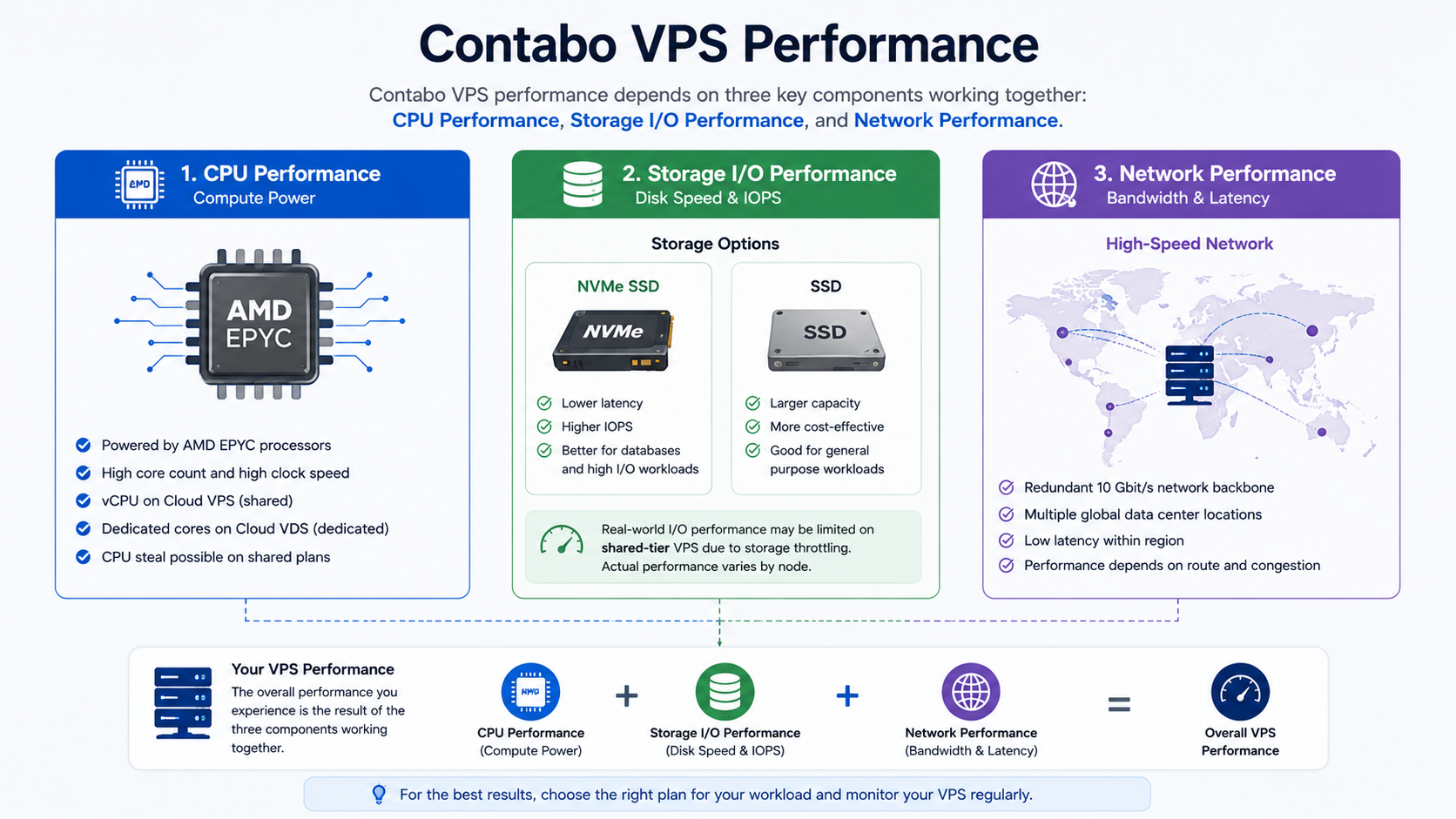
| Product Line | Resource Model | Main Positioning | Best For |
|---|---|---|---|
| Core VPS | Shared virtualized resources | Cost-efficient general-purpose VPS | Websites, blogs, CMS, private email, file servers, development, testing, backups |
| Performance VPS | Shared vCPU on newer hardware | Higher-performance VPS for modern workloads | Databases, Kubernetes, CI/CD, APIs, AI-ready workloads, n8n |
| Max Performance VDS | Dedicated CPU and RAM in a virtualized environment | Predictable, consistent performance | SaaS, high-traffic applications, real-time workloads, business-critical systems |
| Dedicated Servers | Dedicated physical hardware | Maximum hardware control and physical isolation | High-frequency workloads, compliance, maximum disk I/O, custom hardware, AI inference |
The important distinction is between shared resources, dedicated virtual resources, and dedicated physical hardware.
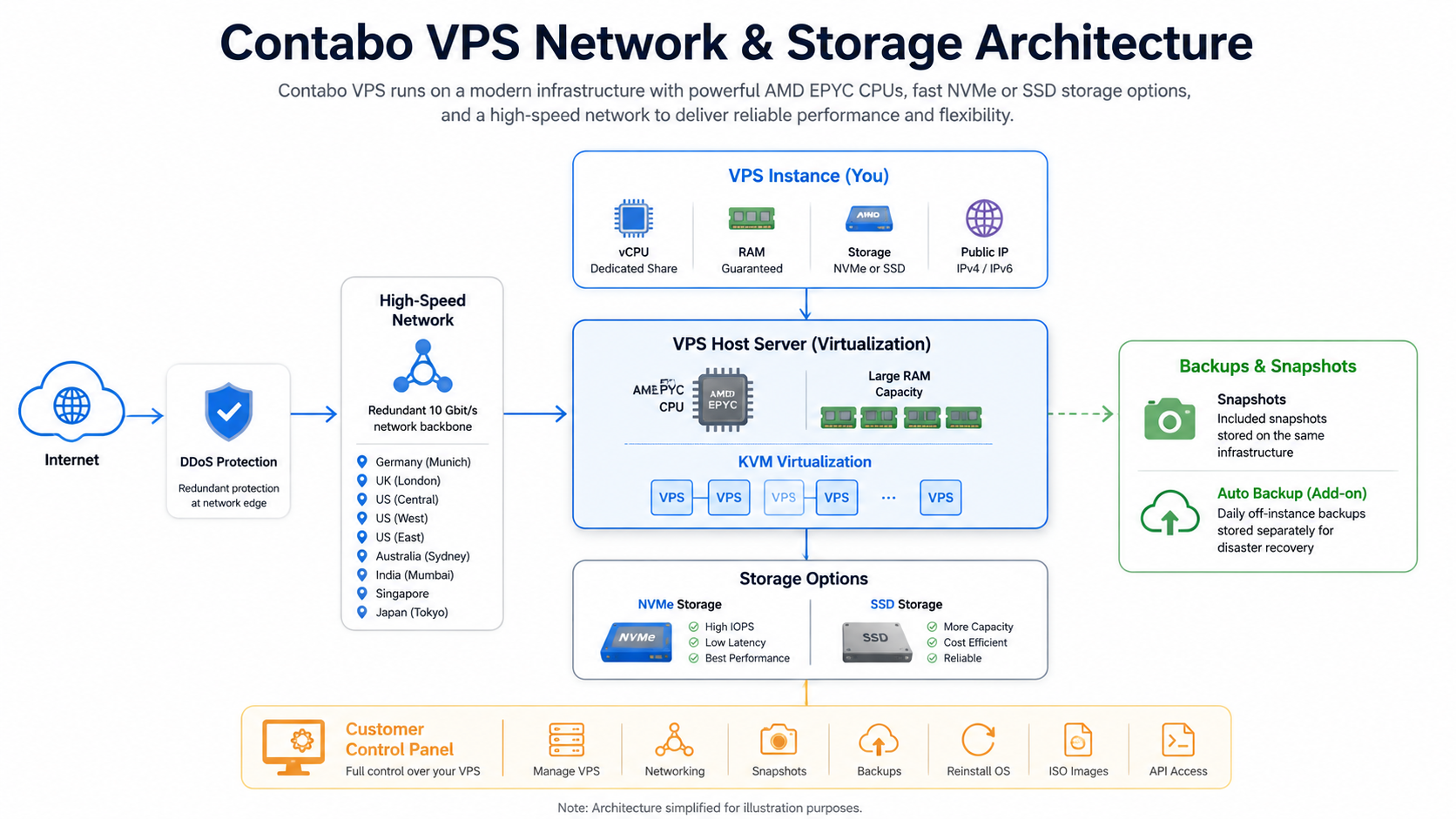
Core VPS and Performance VPS both remain virtualized VPS products. Performance VPS is positioned for more demanding workloads and uses newer AMD EPYC hardware, but its vCPU resources remain shared. Max Performance VDS changes the resource model: CPU and RAM are dedicated while the server remains virtualized. Dedicated Servers go one step further by providing an entire physical machine without a virtualization layer.
That makes the four products complementary rather than simply sequential upgrades.
Core VPS: Cost-Efficient General-Purpose Hosting
What Is Core VPS?
Core VPS is the entry point into Contabo’s new 2026 portfolio and is designed around a straightforward principle: pay for the resources the workload actually needs rather than automatically moving to higher-performance infrastructure.
It is positioned for stable, general-purpose workloads where cost efficiency is more important than maximum sustained compute performance. Typical examples include websites, blogs, CMS installations, private email, file servers, development and testing environments, and backup or storage-related workloads.
That makes Core VPS particularly relevant for smaller websites and online projects that need more control than conventional shared hosting but do not have a workload that justifies a higher-performance VPS or dedicated resources.
Core VPS Pricing
| Plan | EUR / Month | USD / Month | GBP / Month | Discount |
|---|---|---|---|---|
| Core VPS 4 | €4.40 | $5.28 | £4.32 | 20% / 24M |
| Core VPS 6 | €6.00 | $7.20 | £5.88 | 20% / 24M |
| Core VPS 8 | €11.20 | $13.44 | £10.96 | 20% / 24M |
| Core VPS 12 | €20.00 | $24.00 | £19.52 | 20% / 24M |
| Core VPS 16 | €29.60 | $35.60 | £28.80 | 20% / 24M |
| Core VPS 18 | €39.20 | $47.04 | £38.16 | 20% / 24M |
Prices exclude VAT. The listed pricing reflects the 20% discount associated with a 24-month subscription.
The pricing range gives Core VPS a relatively broad role. The lowest-priced plans can serve straightforward websites and development environments, while the higher Core VPS configurations provide more room for workloads that have grown beyond the entry level but still do not require the performance characteristics of the Performance VPS line.
What Core VPS Is Good At
Core VPS makes the most sense when the workload is relatively predictable and does not continuously push CPU resources.
Typical use cases include:
- WordPress and other CMS websites
- Blogs and content sites
- Private email servers
- File servers
- Development and testing
- Staging environments
- Backup and general storage workloads
Its main advantage is therefore not simply its low entry price. The bigger advantage is that the product is intentionally positioned around cost-efficient infrastructure for workloads that do not need premium compute resources.
The trade-off is equally straightforward: if an application begins experiencing sustained CPU pressure or requires consistently higher compute performance, moving up to Performance VPS becomes more logical than continuing to optimize around a Core VPS configuration.
Performance VPS: Higher-Performance VPS for Modern Workloads
What Is Performance VPS?
Performance VPS occupies the next level of Contabo’s 2026 portfolio. It is still a VPS, but the hardware and workload positioning are substantially different from Core VPS.
The product line uses newer AMD EPYC hardware, includes NVMe storage as standard, and is designed for modern workloads that require stronger compute performance and sustained performance under load. It also targets workloads such as databases, Kubernetes, CI/CD, APIs, n8n, and AI-ready or local inference applications.
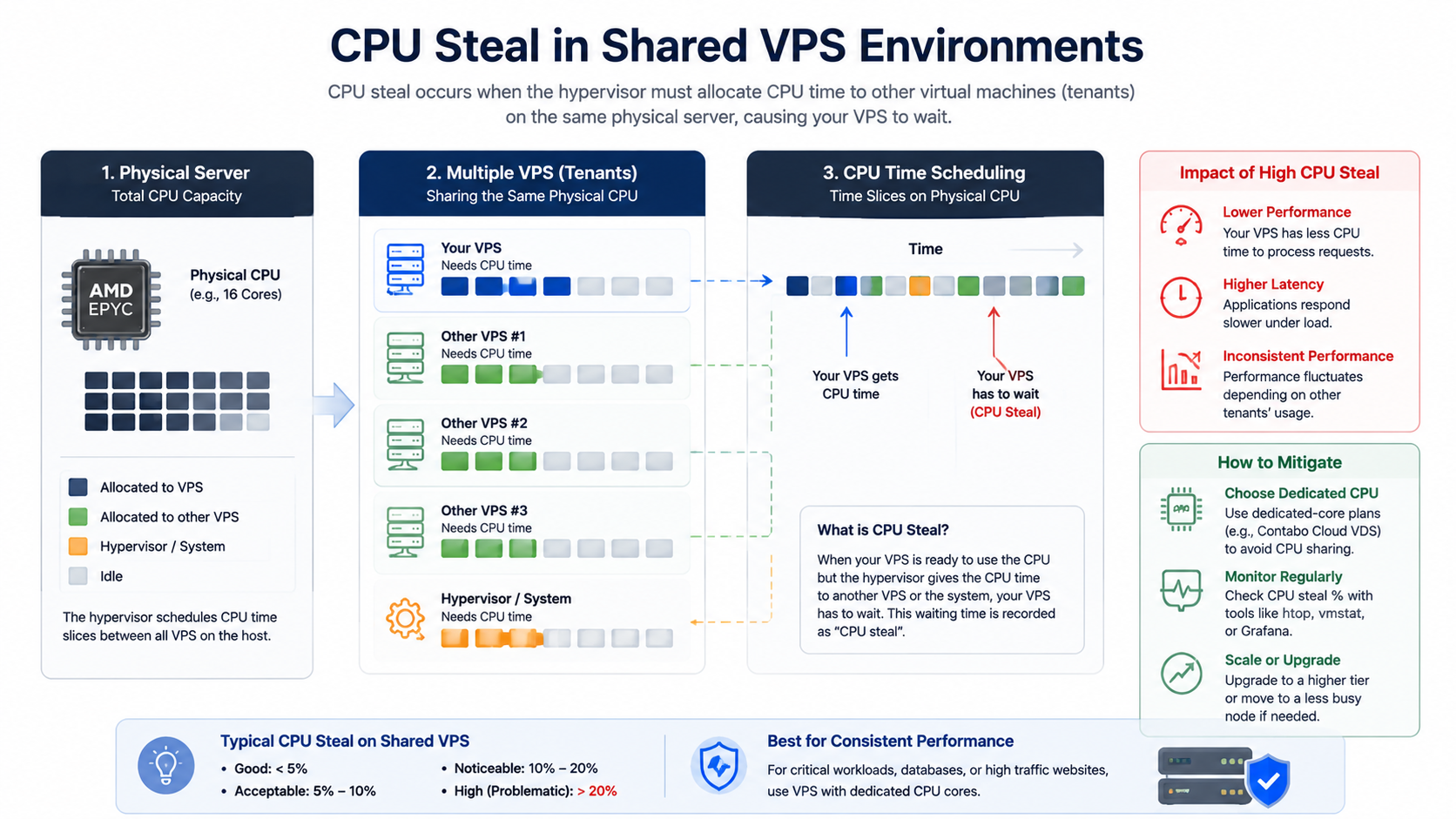
There is one distinction worth keeping clear: Performance VPS does not provide dedicated CPU resources. Its vCPUs remain shared. The product is therefore aimed at users who want a higher-performance VPS environment without moving to the dedicated-resource model of VDS.
Performance VPS Pricing
| Plan | EUR / Month | USD / Month | GBP / Month | Discount |
|---|---|---|---|---|
| Performance VPS 4 | €10.80 | $13.00 | £10.40 | 20% / 24M |
| Performance VPS 6 | €15.20 | $18.40 | £14.60 | 20% / 24M |
| Performance VPS 8 | €28.00 | $33.60 | £27.00 | 20% / 24M |
| Performance VPS 12 | €47.20 | $56.80 | £45.40 | 20% / 24M |
| Performance VPS 16 | €63.20 | $76.00 | £60.80 | 20% / 24M |
| Performance VPS 18 | €79.20 | $95.20 | £76.00 | 20% / 24M |
Prices exclude VAT. The listed pricing reflects the 20% discount associated with a 24-month subscription.
The pricing is higher than Core VPS, but that difference reflects a different workload target rather than simply a larger version of the same product.
Where Performance VPS Makes More Sense
Performance VPS is the more appropriate choice when a workload has moved beyond basic hosting requirements and compute performance has become a meaningful constraint.
Examples include:
- Database workloads
- API services
- Kubernetes clusters
- CI/CD environments
- n8n and similar automation platforms
- CPU-intensive applications
- AI-ready workloads
- Local AI inference
The practical upgrade signal is not simply that a website has become more expensive to operate. It is that the workload itself is beginning to require more consistent compute capability—for example, CPU pressure increases, API response times deteriorate under load, or builds and other compute-heavy operations take longer.
The limitation is that Performance VPS still uses shared vCPU resources. For workloads where resource contention is unacceptable and performance must remain predictable, the next step is not another Performance VPS configuration—it is Max Performance VDS.
Check Performance VPS specs & pricing
Max Performance VDS: Dedicated Resources in a Virtualized Environment
What Is Max Performance VDS?
Max Performance VDS is where Contabo changes the resource model rather than simply increasing VPS performance.
Unlike Core VPS and Performance VPS, where CPU resources remain shared, Max Performance VDS provides dedicated CPU and RAM within a virtualized environment. The underlying server is still virtualized, but the resources assigned to the VDS are exclusively allocated to the customer.
This makes VDS the practical middle ground between a conventional VPS and a physical dedicated server.
The distinction is important:
-
Performance VPS: shared vCPU, higher-performance hardware
-
Max Performance VDS: dedicated CPU and RAM, still virtualized
-
Dedicated Server: physical hardware, no virtualization layer
For workloads where performance needs to remain consistent rather than simply reach a higher peak, this difference can matter more than the raw monthly price.
Max Performance VDS Pricing
| Plan | EUR / Month | USD / Month | GBP / Month | Discount |
|---|---|---|---|---|
| Max Performance VDS S | €39.20 | $47.20 | £38.40 | 20% / 24M |
| Max Performance VDS M | €49.60 | $59.60 | £48.80 | 20% / 24M |
| Max Performance VDS L | €69.60 | $83.60 | £68.40 | 20% / 24M |
| Max Performance VDS XL | €94.40 | $113.60 | £92.80 | 20% / 24M |
| Max Performance VDS XXL | €139.20 | $167.20 | £136.80 | 20% / 24M |
Prices exclude VAT. The listed pricing reflects the 20% discount associated with a 24-month subscription.
Why Dedicated Resources Change the Equation
The main advantage of VDS is predictability.
A shared VPS can be perfectly adequate for many workloads, but workloads that depend on consistent CPU and memory availability have a different requirement. With dedicated CPU and RAM, VDS is designed to avoid the resource contention associated with shared environments.
That makes the product particularly relevant when an application has become too important to tolerate unpredictable resource availability but does not yet require an entire physical server.
Typical use cases include:
-
SaaS applications
-
Multi-tenant platforms
-
High-traffic customer-facing services
-
Real-time workloads
-
Business-critical applications
-
Workloads with strict SLA requirements
-
AI inference
There is, however, a trade-off. VDS remains virtualized. It therefore does not provide the same level of physical hardware control as a Dedicated Server. If the workload requires complete physical isolation, maximum disk I/O, custom hardware, or no virtualization layer, moving to a dedicated server is the more appropriate decision.
In other words, VDS is not simply a more expensive VPS. It is the option for workloads where resource predictability becomes more important than keeping the server at the lowest possible cost.
Dedicated Servers: Maximum Hardware Control
What Is a Contabo Dedicated Server?
Dedicated Servers represent the top end of Contabo’s 2026 server portfolio.
The difference from VDS is fundamental: a Dedicated Server is a physical machine exclusively allocated to one customer. There is no virtualization layer between the operating system and the physical server hardware, giving the customer full control over the machine and direct access to its physical resources.
This makes Dedicated Servers appropriate for workloads where physical isolation, maximum I/O performance, or hardware-level control matters more than the flexibility and lower cost of virtualization.
The 2026 portfolio includes AMD Ryzen, AMD Genoa, and AMD Turin-based options.
Dedicated Server Pricing
| Server | EUR / Month | USD / Month | GBP / Month | Discount |
|---|---|---|---|---|
| AMD Ryzen 12 Cores | €134.10 | $161.10 | £131.40 | 10% / 12M |
| AMD Genoa 24 Cores | €179.10 | $215.10 | £175.50 | 10% / 12M |
| AMD Turin 32 Cores | €359.10 | $431.10 | £351.90 | 10% / 12M |
| AMD Turin 64 Cores | €629.10 | $755.10 | £616.50 | 10% / 12M |
Prices exclude VAT. The listed pricing reflects the 10% discount associated with a 12-month subscription.
When Dedicated Hardware Makes Sense
Dedicated hardware is aimed at workloads where the advantages of physical ownership outweigh the higher cost.
The 2026 portfolio specifically positions Dedicated Servers for:
-
High-frequency workloads
-
Compliance requirements
-
Maximum disk I/O
-
Custom hardware requirements
-
AI inference
The strongest advantage is control. There are no shared physical server resources and no virtualization layer to account for. That gives the customer a fundamentally different environment from both VPS and VDS.
The obvious downside is cost. Starting at €134.10 per month, Dedicated Servers are considerably more expensive than the VPS and VDS ranges. For a normal website or development environment, that additional hardware would usually be unnecessary.
That is precisely why Dedicated Servers should not be treated as the automatic “best” option. They are the right option when physical isolation, maximum I/O, or hardware control is actually required.
Core VPS vs Performance VPS vs VDS vs Dedicated Servers
The four products become much easier to distinguish when the underlying resource model is compared directly.
| Feature | Core VPS | Performance VPS | Max Performance VDS | Dedicated Servers |
|---|---|---|---|---|
| Environment | Virtualized | Virtualized | Virtualized | Physical |
| CPU Resources | Shared | Shared | Dedicated | Physical |
| RAM Resources | Shared model | Shared model | Dedicated | Physical |
| Resource Isolation | Shared | Shared | Dedicated | Full physical isolation |
| Main Priority | Cost efficiency | Compute performance | Predictable performance | Maximum hardware control |
| Virtualization Layer | Yes | Yes | Yes | No |
| Hardware Control | Limited | Limited | Virtual server level | Full |
| Best For | General workloads | Modern high-load workloads | Business-critical workloads | Maximum I/O, isolation, control |
The most important comparisons are not between the four products as a simple price ladder. They are between the resource models.
Core VPS vs Performance VPS
Both are virtualized VPS products, so the question is primarily whether the workload needs the stronger performance positioning of the Performance VPS range.
Core VPS makes more sense when cost efficiency is the priority and the workload is relatively straightforward.
Performance VPS makes more sense when CPU-intensive or modern application workloads justify newer AMD EPYC hardware, NVMe storage, and the higher-performance positioning.
The trade-off remains shared vCPU resources.
Performance VPS vs Max Performance VDS
This is the more important distinction for production workloads.
Performance VPS provides higher-performance shared VPS infrastructure. VDS provides dedicated CPU and RAM.
So the question is not simply whether VDS is faster. The more useful question is whether the workload requires predictable dedicated resources.
If shared vCPU is acceptable, Performance VPS can provide a more cost-efficient solution. If resource contention cannot be tolerated, VDS becomes the logical step up.
Max Performance VDS vs Dedicated Server
Both are designed for demanding workloads, but their architectures are different.
VDS provides dedicated resources inside a virtualized environment.
Dedicated Servers provide the physical machine itself, without a virtualization layer.
Therefore, VDS is the better middle ground when dedicated resources and predictable performance are required without moving to bare metal. Dedicated Servers make more sense when physical isolation, maximum I/O, custom hardware, or complete hardware control is the actual requirement.
Contabo 2026 Pricing at a Glance
Looking at the entire portfolio, the pricing structure reflects those four resource models rather than a simple collection of unrelated server plans.
| Product Line | Starting Price | Highest Listed Price | Discount | Subscription Term |
|---|---|---|---|---|
| Core VPS | €4.40/mo | €39.20/mo | 20% | 24 months |
| Performance VPS | €10.80/mo | €79.20/mo | 20% | 24 months |
| Max Performance VDS | €39.20/mo | €139.20/mo | 20% | 24 months |
| Dedicated Servers | €134.10/mo | €629.10/mo | 10% | 12 months |
All listed prices exclude VAT.
This also makes the product progression easier to interpret. Core VPS covers the low-cost general-purpose end of the portfolio, Performance VPS targets stronger compute requirements, VDS introduces dedicated virtual resources, and Dedicated Servers move to complete physical isolation.
The right choice therefore depends less on finding the cheapest available plan and more on identifying where the workload sits within that progression.
Other Contabo Products and Configuration Options
The four product lines form the core of Contabo’s 2026 server portfolio, but they are not the only considerations when configuring a server. Storage, data center location, operating system, and network configuration can affect the final setup just as much as the base product.
Storage VPS
Storage VPS should be treated separately from the four core product lines rather than presented as a fifth tier in the Core → Performance → VDS → Dedicated progression.
Its purpose is straightforward: **large-capacity storage-oriented workloads**.
That makes it relevant for use cases such as:
– Large file storage
– Backup repositories
– Archives
– Data-heavy applications where storage capacity matters more than compute performance
This distinction is useful because a storage-heavy workload does not necessarily need to move up to a more expensive compute-focused product. If the primary requirement is capacity, a storage-oriented product can be more appropriate than paying for additional compute resources that the workload will not use.
For storage configurations, NVMe is more suitable for performance-sensitive workloads, while lower-cost storage options may be a better fit when capacity and cost are the main priorities.
Data Center Location
Data center location is primarily a performance and latency decision.
For a website or application serving users in a particular geographic region, choosing a data center closer to the majority of those users can reduce network latency. For applications that communicate with other services, databases, APIs, or external infrastructure, the location of those dependencies can matter as well.
The practical rule is simple:
Choose the location based on where the workload and its users are, not simply on which location appears cheapest.
Bandwidth and Network Configuration
Contabo’s current network policy does not use a simple default monthly bandwidth cap in the way some VPS providers do. Fair-use conditions apply, while available port speeds depend on the product and configuration.
For VPS and VDS products, current port speeds can range from 100 Mbps to 1 Gbps. Dedicated Server configurations are generally offered with 100 Mbps, with some higher-end configurations supporting 1 Gbps.
This matters when evaluating a server for high-traffic applications. Port speed and monthly transfer policy are different concepts: a higher port speed determines how quickly data can be transferred at a given moment, while the provider’s traffic policy determines how the service can be used over time.
How to Choose the Right Contabo Product
The easiest way to choose between the four product lines is to start with the workload rather than the price.
| Requirement | Recommended Product |
|---|---|
| Lowest-cost general-purpose server | Core VPS |
| Website, blog, or CMS | Core VPS |
| Development and testing | Core VPS |
| Backup or general storage workload | Core VPS |
| Increasing CPU pressure | Performance VPS |
| Database workloads | Performance VPS |
| API services | Performance VPS |
| Kubernetes / CI/CD | Performance VPS |
| AI-ready or local inference workloads | Performance VPS |
| Dedicated resources | Max Performance VDS |
| Predictable performance | Max Performance VDS |
| High-traffic customer-facing applications | Max Performance VDS |
| SaaS / multi-tenant platforms | Max Performance VDS |
| Strict SLA requirements | Max Performance VDS |
| Maximum disk I/O | Dedicated Server |
| Physical isolation | Dedicated Server |
| Compliance requirements | Dedicated Server |
| Custom hardware | Dedicated Server |
| No virtualization layer | Dedicated Server |
The table also shows why choosing purely by budget can lead to the wrong product.
A Core VPS may be the best-value option for a normal website, but it is not necessarily the best choice once CPU pressure becomes a persistent problem. Likewise, a Performance VPS can be an excellent balance for compute-heavy applications, but it does not provide the dedicated CPU and RAM of a VDS.
The progression is therefore better understood as a series of workload decisions:
Core VPS → Do I need stronger compute? → Performance VPS
Performance VPS → Do I need dedicated resources and predictable performance? → VDS
VDS → Do I need physical hardware and no virtualization layer? → Dedicated Server
Contabo 2026: Strengths and Limitations
A useful Contabo review should not treat every limitation as a reason to reject the service. Most of the trade-offs are directly connected to how the four product lines are designed.
Core VPS
Advantages
-
Lowest entry price in the new portfolio
-
Designed for cost-efficient general-purpose workloads
-
Suitable for websites, CMS, development, testing, and backups
-
Broad enough range to accommodate growing general-purpose workloads
Limitations
-
Shared resource model
-
Not designed around maximum sustained compute performance
-
Users with increasingly demanding CPU workloads may eventually benefit from Performance VPS
The important point is that these limitations are consistent with the product’s purpose. Core VPS is not intended to compete with dedicated-resource infrastructure on performance consistency.
Performance VPS
Advantages
-
Newer AMD EPYC hardware
-
NVMe storage as standard
-
Higher-performance positioning than Core VPS
-
Suitable for databases, Kubernetes, CI/CD, APIs, and AI-ready workloads
-
Retains the flexibility and lower-cost structure of a VPS
Limitations
-
vCPU resources remain shared
-
It is therefore not equivalent to a dedicated-resource VDS
-
Workloads requiring strictly predictable resource availability may be better suited to VDS
The advantage is precisely this balance: Performance VPS moves significantly toward higher-performance workloads without requiring the cost of dedicated virtual or physical resources.
Max Performance VDS
Advantages
-
Dedicated CPU and RAM
-
Predictable and consistent resource availability
-
No resource contention from other customers for the dedicated resources
-
Suitable for production, SaaS, high-traffic, and business-critical workloads
-
Provides a middle ground between shared VPS and bare metal
Limitations
-
Still uses virtualization
-
More expensive than the VPS ranges
-
Does not provide the same physical hardware control as a Dedicated Server
For many production workloads, that trade-off is actually the point. VDS provides dedicated resources without requiring the customer to move all the way to physical hardware.
Dedicated Servers
Advantages
-
Entire physical server allocated to one customer
-
No virtualization layer
-
Full hardware control
-
Maximum disk I/O potential
-
Suitable for physical isolation, compliance, custom hardware, and demanding workloads
Limitations
-
Significantly higher starting price
-
Less economical for ordinary websites and smaller workloads
-
Physical hardware is unnecessary when the workload can comfortably run on VPS or VDS infrastructure
Dedicated Servers therefore represent the maximum-control option rather than the universally superior option.
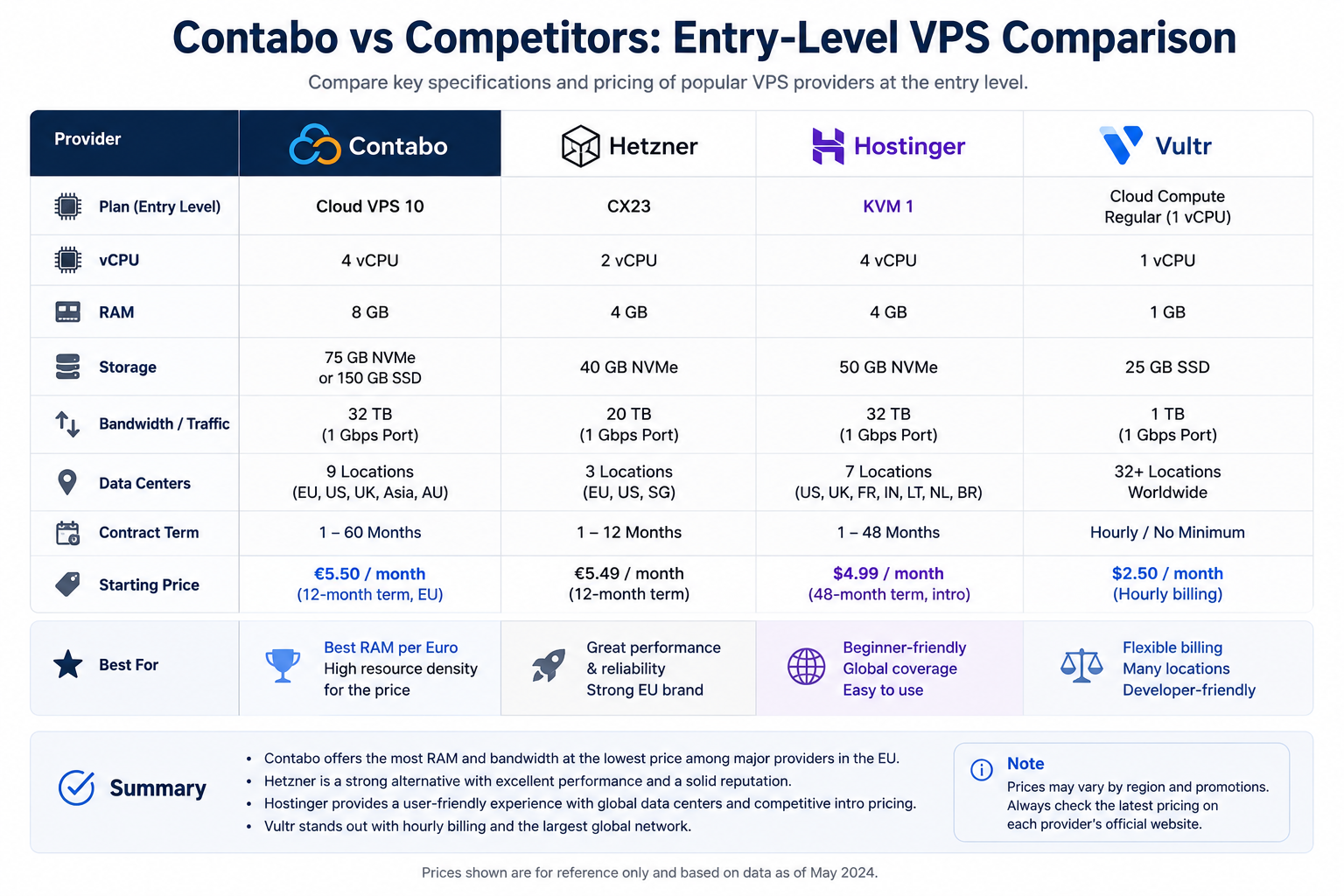
Which Contabo Product Offers the Best Value?
There is no single answer because the four product lines optimize for different things.
For a normal website, blog, CMS, development environment, or backup workload, Core VPS offers the most straightforward value because the product is designed around keeping infrastructure costs under control.
For workloads where compute performance has become important but shared vCPU remains acceptable, Performance VPS provides the more appropriate balance.
For applications where performance must be predictable and CPU/RAM resources need to be dedicated, Max Performance VDS becomes more compelling.
For workloads that require physical isolation, maximum I/O, custom hardware, or complete control of the underlying machine, Dedicated Servers justify their much higher price.
The best-value product is therefore the one whose resource model matches the workload—not necessarily the one with the lowest monthly price.
Is Contabo a Good Choice for Online Businesses?
The new 2026 portfolio makes Contabo more interesting for online businesses because the product range now covers several very different stages of infrastructure requirements.
For a new website or relatively light business workload, Core VPS is usually the logical starting point. It provides a low-cost VPS environment without paying for performance that the application may not yet need.
As the workload grows, the decision becomes more performance-oriented. Performance VPS is designed for applications that need stronger compute capabilities, newer AMD EPYC hardware, NVMe storage, and higher-performance infrastructure while still accepting shared vCPU resources.
For businesses where infrastructure consistency becomes critical, Max Performance VDS changes the equation. Dedicated CPU and RAM make it better suited to applications where unpredictable resource availability is no longer acceptable.
At the top end, Dedicated Servers are intended for workloads that genuinely require physical hardware, maximum disk I/O, physical isolation, or complete hardware control.
This creates a practical progression for an online business:
Start with the resources you actually need → upgrade when the workload demands it → move to dedicated resources when consistency becomes critical → use bare metal when physical hardware control is required.
That is a more useful way to evaluate Contabo than simply asking which plan has the lowest price.
Is Contabo Good for WordPress?
For WordPress, the appropriate Contabo product depends heavily on the site’s workload.
A relatively normal WordPress website, blog, or CMS installation does not necessarily require high-performance infrastructure. Core VPS is designed specifically for this type of general-purpose workload and is therefore the natural starting point.
The situation changes when a WordPress site becomes more demanding. High traffic, database activity, background processing, or other CPU-intensive workloads can make Performance VPS more appropriate.
The important distinction is that upgrading should be driven by the site’s actual workload rather than by the assumption that a more expensive server will automatically produce a better website.
For most ordinary WordPress projects:
Core VPS → start here
For more demanding WordPress workloads:
Performance VPS → consider when compute requirements increase
If a WordPress-based business eventually requires dedicated CPU and RAM with predictable performance, Max Performance VDS becomes the next logical step.
Is Contabo Good for Developers?
Contabo’s new portfolio also covers a broad range of development workloads.
Core VPS can handle common development requirements, including development and testing environments, staging instances before deployment, smaller application servers, and backup or temporary server setups. This makes it a practical choice when an independent server environment is needed without requiring high-end compute resources.
For heavier workloads, Performance VPS offers additional capacity for CI/CD workflows, API applications, Kubernetes environments, database workloads, n8n automation, and AI-ready projects. Powered by newer AMD EPYC hardware, this option delivers a stronger performance foundation while maintaining the flexibility of VPS infrastructure.
Shared vCPU resources remain a factor to consider. Projects that require guaranteed dedicated CPU performance may be better suited to VDS instead.
Contabo for AI and Modern Workloads
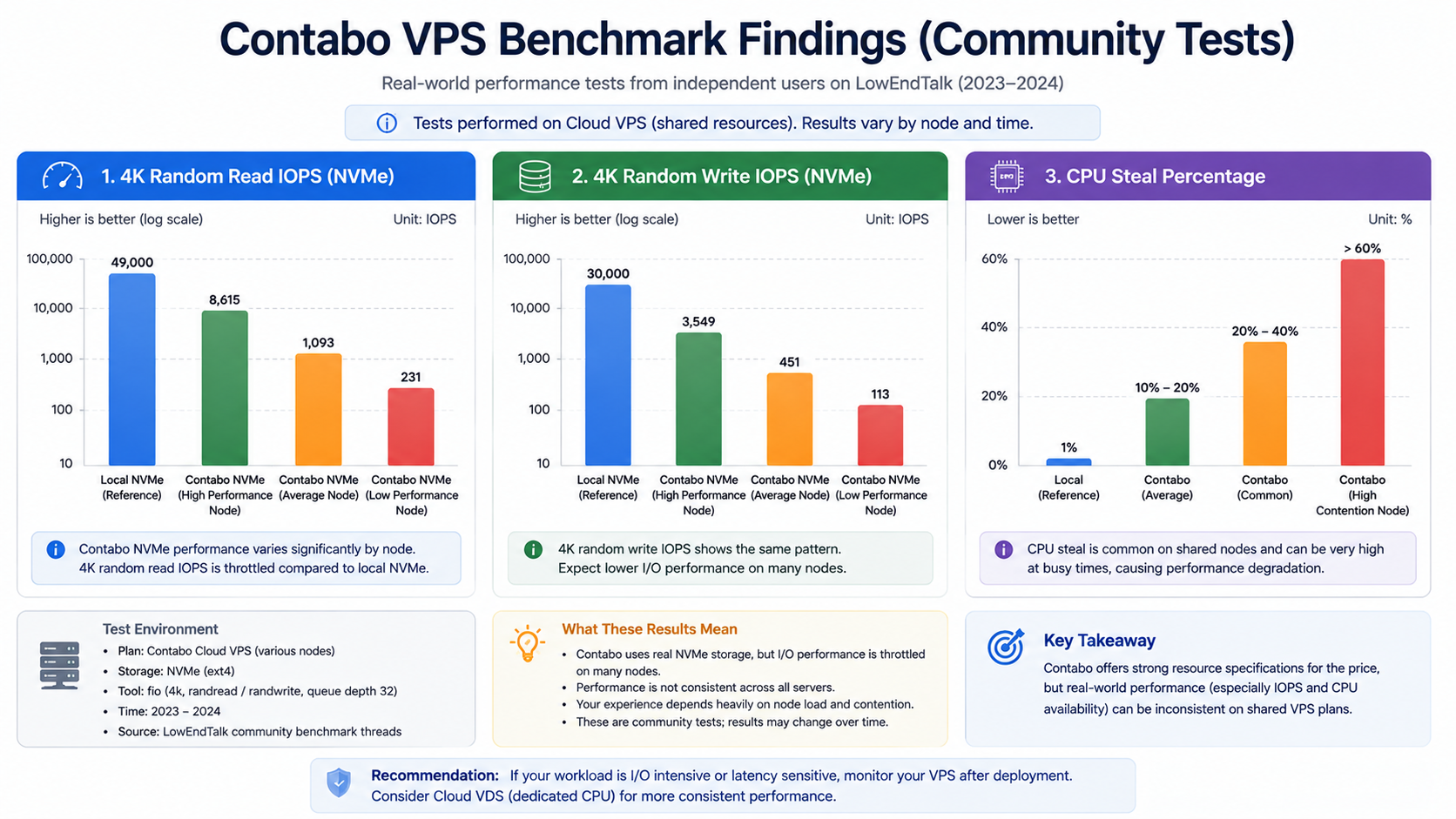
The 2026 portfolio positions Performance VPS, VDS, and Dedicated Servers for different levels of resource-intensive workloads, including AI-related use cases.
Performance VPS provides a practical entry point for AI-ready workloads and local inference where shared vCPU resources are acceptable.
When dedicated CPU and RAM with predictable performance are required, VDS becomes the more suitable option.
For workloads that need physical hardware control, maximum I/O, or complete isolation, Dedicated Servers provide the highest level of resources.
This distinction matters because “AI workload” does not automatically mean “Dedicated Server.” The infrastructure requirement depends on what the application is actually doing.
Contabo 2026: Final Verdict
Contabo’s 2026 portfolio is considerably easier to evaluate when the products are separated by resource model rather than treated as a simple list of increasingly expensive servers.
Core VPS
Best for: cost-efficient general-purpose workloads.
Core VPS is the sensible starting point for websites, CMS platforms, development, testing, email, file servers, and backups. Its main advantage is cost efficiency, while its shared resource model means it is not intended for workloads demanding consistently higher compute performance.
Performance VPS
Best for: modern, more demanding workloads that still work well with shared vCPU.
Performance VPS adds newer AMD EPYC hardware, NVMe storage, and a higher-performance orientation. It is a strong middle option for databases, APIs, Kubernetes, CI/CD, automation, and AI-ready workloads.
Its limitation is also clear: CPU resources remain shared.
Max Performance VDS
Best for: workloads requiring dedicated resources and predictable performance.
VDS provides dedicated CPU and RAM while retaining virtualization. That makes it particularly useful for SaaS, multi-tenant applications, high-traffic services, real-time workloads, and business-critical systems.
The trade-off is that it still does not provide the physical hardware control of a dedicated server.
Dedicated Servers
Best for: maximum hardware control and physical isolation.
Dedicated Servers provide the entire physical machine without a virtualization layer. They are designed for workloads where maximum I/O, compliance, physical isolation, custom hardware, or complete hardware control justify the substantially higher cost.
The Bottom Line
The strongest part of Contabo’s 2026 lineup is not any individual plan. It is the clear separation between the four resource models.
| If Your Priority Is… | Choose… |
|---|---|
| Cost efficiency | Core VPS |
| Higher compute performance | Performance VPS |
| Dedicated resources and predictable performance | Max Performance VDS |
| Maximum hardware control and physical isolation | Dedicated Servers |
The most important buying principle is therefore simple:
Choose according to workload requirements first, and price second.
A Core VPS is not “worse” than a VDS simply because it costs less. A VDS is not automatically a better choice than Performance VPS simply because its CPU and RAM are dedicated. And a Dedicated Server is not necessarily better value than a VDS if the workload does not require physical hardware.
The right Contabo product is the one whose resource model matches the actual demands of the application.
Compare All Contabo Server Plans
Frequently Asked Questions
Yes, but the appropriate product depends on the workload. Core VPS is suitable for ordinary WordPress websites, blogs, and CMS workloads where cost efficiency is the priority. Performance VPS becomes more appropriate when CPU-intensive workloads, higher traffic, databases, or other demanding application requirements make stronger compute performance important. For workloads requiring dedicated CPU and RAM, Max Performance VDS is the next step.
Use the workload to determine the product:
- Core VPS — general-purpose workloads and cost efficiency
- Performance VPS — higher-performance workloads with shared vCPU
- Max Performance VDS — dedicated CPU/RAM and more predictable performance
- Dedicated Servers — physical isolation, maximum I/O, and full hardware control
The key distinction is not simply how much each product costs. It is how the resources are allocated and what level of performance consistency and hardware control the workload requires.
Yes. NVMe is available across the current VPS portfolio, while the Performance VPS range uses NVMe storage as standard. This makes the Performance VPS a more logical choice for workloads where storage performance is important, including databases and other I/O-sensitive applications.
Yes. VPS and VDS instances can be upgraded through the Customer Panel. Contabo’s step‑by‑step upgrade guide An upgrade does not normally change the IP address, and live migration can be performed without data loss where supported. However, direct downgrades are not supported; moving to a smaller configuration requires ordering a new server and canceling the existing one.
Contabo does not apply a standard bandwidth limit to VPS, VDS, or Dedicated Servers, although its fair-use policy still applies. Port speeds depend on the product, with VPS and VDS configurations ranging from 100 Mbps to 1 Gbps.
Not with nested virtualization. Contabo states that nested virtualization is supported on Dedicated Servers and VDS, but not on VPS products. If running your own virtual machines or hypervisor is a requirement, a VDS or Dedicated Server is therefore the appropriate option.
The first step is to identify the actual bottleneck rather than immediately changing products. CPU, memory, disk I/O, and network conditions can each produce different symptoms. If the workload has outgrown a Core VPS, Contabo recommends moving to Performance VPS for higher compute and storage performance, or to Max Performance VDS when more consistent dedicated resources are required.
It can be, but the appropriate tier depends on how the workload behaves under sustained traffic. Performance VPS is positioned for performance-sensitive applications, while Max Performance VDS is intended for high-traffic and customer-facing platforms where dedicated resources and more predictable performance are important. Dedicated Servers are the stronger choice when physical isolation, maximum I/O, or full hardware control is required.
Contabo does not automatically back up your server data as a standard infrastructure guarantee. Backups are something you need to configure separately if you require them. Contabo also distinguishes snapshots from backups: a snapshot captures the current state of a VPS for rollback purposes, but it should not be treated as a standalone backup strategy.
Snapshots are available for supported Cloud VPS plans and can be created from the Customer Control Panel. They are useful when making system changes because you can roll the VPS back to an earlier state if an update or configuration change causes problems. However, snapshots are automatically deleted after 30 days and cannot be downloaded, so they should not replace an independent backup strategy.
Contabo provides a Rescue System for VPS, VDS, and Dedicated Servers. It can be booted through the Customer Control Panel and provides temporary access to the server so you can troubleshoot problems, recover files, or repair configuration issues that prevent normal access.
Yes. A VPS, VDS, or Dedicated Server can be canceled through the Customer Panel, and the service remains active until the displayed termination date. Before canceling a VPS, however, make sure any required data has been backed up or transferred because cancellation permanently deletes the associated snapshots and backups and cannot be reversed.
A private customer may request revocation within the first 14 days of a new Contabo contract, subject to the applicable conditions. For an automatically renewed service, Contabo states that a refund request should be submitted to support within 72 hours of the renewal. Refund eligibility can depend on the specific situation, so the applicable cancellation and revocation terms should be checked before relying on a refund.


